Wednesday, 10 August 2016

Green Liberty: The Third Six Months of M4D

E-bulletin “Development Cooperation News” 
To enrich awareness of society and policymakers in Latvia about global interconnection, challenges and initiatives to solve them both globally and locally we have started to publish electronic information bulletin Development Cooperation News (DCN).
DCN is published electronically twice a year and features current development cooperation topics from the perspective of practitioners, opinion leaders and policy-makers.
The 3rd issue is Sustainable Development Goals. It is looking for answers on the following questions: How can we reduce global poverty, inequality, injustice, and climate change by empowering development of our local communities? This global and local news is published in five sections – POSITIONS, EVENTS, EXPERIENCE, OPINIONS, and RESOURCES that shape the structure of DCN.
Read and download the bulletin Development Cooperation News here.
The next – 4th issue of Development Cooperation News will be on how to measure Sustainable Development Goals

Joint Study Trip to Palestine 

A journalist from regional newspaper Zemgales Ziņas - Agnese Leiburga represented Green Liberty the joint study trip to Palestine on the July 11-17. This study trip was organized by project’s Finnish partner organization VIKES. During the trip Agnese Leiburga together with her colleagues from other M4D partner organizations – Estonia, Lithuania, Latvia, Czech Republic and Slovakia visited Bethlehem, Beit Sahour, Palestinian refugee camp Aida in Bethlehem, Hebron, Jerusalem, and Abu Dis – city, which has been cut away from Jerusalem by the Israeli separation wall. During these visits there was a chance to interview Bashir and Jeanette who are well-traveled Palestinian-Christian couple and have decided to live in Bethlehem, as well as Palestinian family affected by the separation wall, to visit Bethlehem University with the participants of the media camp and much more.
Reflections on situations and experience have been published in several proceeding articles and are available here:
Leiburga, Agnese, (July-August, 2016). Viena žoga divas puses – Izraēla un Palestīna. [Two sides of the same fence: Israel and Palestine]. Zemgales Ziņas [regional newspaper Zemgale News],
- August 11, 2016:

Helsinki Intensive Course “Reporting World News” for Journalists 

On April 20-22 three Latvian writing journalists who have recently started their career together with their colleagues from other M4D partner organizations – Estonia, Lithuania, Latvia, Czech Republic and Slovakia – deepened their awareness and understanding about reflecting on global development issues in an Intensive Course on Development for Journalists in Helsinki. Green Liberty was represented by Iveta Sondore (Vides Vēstis), Anna Ūdre (FEJS Latvija) and Santa Logina (regional newspaper Zemgales Ziņas). The intensive course was organized by project’s Finnish partner organization VIKES. The focus of the course was on such topics as timely media issues in global context, sustainable development, natural resources and disasters, migration and war coverage. The seminar was a great success because of its relevant content, discussions and workshops, organization and atmosphere.

Photo and Story Competition Winners’ Trip to Kenya 

From February 28 till March 23 a group of two people representing Green Liberty had a possibility to explore Kenya and challenge our stereotypes on life in East Africa. Lasma Ozola was interested in sustainable agriculture practices in Kenya. Liene Bieza – a photographer – captured group’s moves during the travel. Also, Liene Bieza and Lasma Ozola were the winners of the photo/story competition Decent Life for All. Lasma and Liene were accompanied by Dimitri Vanham from Belgium who was documenting interviews with project developers in video.
During three weeks they travelled through different regions of Kenya to see Laikipia Permaculture Project, Sustainable Village Resources Organic Coffee project in Rongo, Regenerating Rusinga Project, Drylands Natural Resource Centre Reforestation project in Makueni. Read the reflections in the article Environment, agriculture, community and education in Kenya: Reflections from Green Liberty

Evening Tea with Documentary Journalists 

On the February 17th Kārlis Lesiņš and Lelde Prūse, journalists from the Woodpecker Pictures were invited to an evening tea with Green Liberty’s staff and friends to share the story of their trip to Rwanda and the Democratic Republic of Congo (DRC) where they filmed a documentary movie about the care for protected eastern gorillas (Gorilla beringei beringei andGorilla beringei graueri).
Read the reflections about the event here: Evening tea with documentary journalists

Social Campaign

With a successful piloting in the knowledge festival HELSUS on May 21st in Jelgava we have started a social campaign “Myths and truths about our participation in global development”. The overall address of this social campaign to general public in Latvia is incorporated in the question: Does it seem to you that “we should not help other countries, because we ourselves are poor”, that “poverty results from too high birth rate”, that “help makes a receiver to become lazy”, that “financial assistance is the most needed help for poor countries”, that “climate change is not connected to increase of poverty”? If yes, come and find it out if it is truth or not. Participants interested in finding this out were involved in discussions where they shared their opinions about poverty, birthrate, and impact of rich and poor countries and whether help changes the situation for good or bad. 
The second public debate was during the conversation festival LAMPA on July 1st in Cēsis where we added the next step to our discussion: How to substitute our myths with a rather constructive view on reality?  And why transforming myths to truths is similar to swinging on a swing? The discussion was organized in the LAPAS (Latvian Platform for Development Cooperation) tent that hosted several other discussions, conversations, films, and games about global development organized by NGOs that shared similar vision in the need to lend a hand to make the world a better place.  

Before the campaign we organized an opinion pool that helped us to choose five the most popular myths in Latvia:
    - we should not help other countries, because we ourselves are poor,
     - poverty results from too high birth rate,
     - help makes a receiver to become lazy,
    - financial assistance is the most needed help for poor countries,
    - climate change is not connected to increase of poverty.
We started our discussion with a metaphor of swinging on a swing, and connected it to the process of changing myths to truths. After discussing each myth we shared the relevant results from the opinion pool. Several of proceeding events of the social campaign will be organized in the 2nd part of this year.
Reflections and pictures from piloting the campaign in Helsus: http://www.zalabriviba.lv/par-globalizaciju/tiekamies-sarunu-festivala-lampa/

Photo Exhibition “Decent Life for All”

Green Liberty also organizes a nation-wide photo exhibition Decent Life to All that is ongoing and includes 24 pictures from the photo competition organized in July – September 2015. The pictures included in the exhibition are created by professional and amateur photographers from Estonia, Lithuania, Latvia and Slovakia. Among pictures representing Latvia several of them are created by national winner Liene BiezāThis exhibition provides the visitors an opportunity to think about their daily habits and the world as our global home, and to enhance their understanding of development issues. 
Since its opening at the European Union House in Riga the photo exhibition has been hosted by Latvia University, Latvia University of Agriculture, LU Botanical garden, Gulbene Municipality, Olympic center in Riga, Riga Central Market, shopping centre Galerija Centrs, Latvian National Library restaurant and several other famous restaurants, etc.
The exhibition aims to address general public in Latvia starting from school youngsters to elderly people. By choosing popular and diverse exhibition places we are trying to reach people of different professions and interests. In Gulbene the exhibition was used as a tool for teachers to work with pupils and it helped as educational material in local community.


Regional Journalist Training

Our collaboration with regional newspaper Zemgales Ziņas (Zemgale News) initiated co-organization of regional journalist training Global echoes in regional journalistic that was held on March 11 in Jelgava. The aim of the training was to discuss urgent global issues in the field of journalism, to look for answers about the role of regional journalism in a globalized world, and to enjoy a fair-trade coffee and tea. 
The program implied discussions about the mentioned issues and personal experience stories told by a journalist Kārlis Lesiņš from Woodpecker Pictures who shared the story of his trips to several countries of Global South, including Rwanda and the Democratic Republic of Congo (DRC). 

The training gathered 12 participants who highlighted that events like this provided for regional media are very rare. They shared that this and similar events help to open mind, encourage journalists to look at local activities from a global perspective and at global issues from a local perspective, and to cooperate with each other. Several journalists pointed out that this training confirmed that it is crucial to bring topicalities of a European project to the level of local community.  
Concluding ideas that reflect the issues and reflections covered in the training can be summarized as follows:
Regional journalism has a significant educative purpose, especially in local regional communities where the majority of population do not belong to formal educational system anymore. Thus, local and regional printed media are crucial means of informing and awareness rising for a local community. And this purpose is closely connected to the issue of responsibility.
A journalist is like a woodpecker that hammers persistently until she or he gets to the essence. It is not a routine activity, as a journalist should sustain his or her researcher’s spirit by moving around, observing, gathering information, meeting people and creating stories about fresh issues. Yet, in this activity a balance between expectations from employers and media consumers, available information and resources, and journalist’s own interest and passion should be ensured. A journalist most likely cannot change all the global problems, but what she or he can do is to create stories that can serve the aim to raise awareness and inspire to build hopeful future.
An added value of a story is a presence of journalist’s own culture (ethnic, gender, age, social and economic position, etc.) and its dialogue with the story. 


Friday, 8 July 2016

Mondo activities May-June 2016

MAY

May was a very busy month for Media4Development in Mondo. First, we ordered handicraft baskets from Ghana to use as gifts and awards for different public events and for working with policy makers. It seems that people understand development cooperation through something concrete that they can hold in their hands. What could be better than baskets woven by women in North Ghana where Mondo has helped the local widowers and mothers to create their own basket-weaving and sheabutter-milling cooperatives? The baskets are also co-creation, where the creativity of the women from North Ghana and of Estonian designers are united.

Baskets being made in Kongo village, North Ghana. The women work together as Yen Pang Basket Weavers cooperative.


We also continued preparing for the Opionion Festival coming up in August.

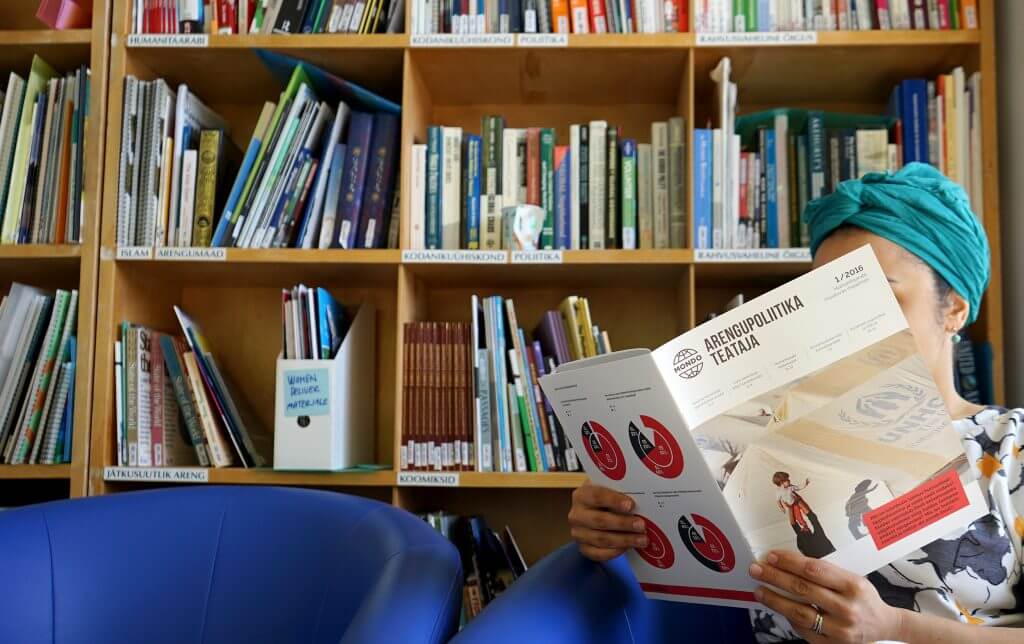
This year’s first Mondo Arvamuspoliitika Teataja (bulletin for policy makers) focussed on humanitarian aid, the World Humanitarian Summit and also gave an overview where Estonia gave humanitarian assistance during 2015. We looked at the underlying principles for the WHS, interviewed Väino Reinart (lead of the Estonian delegation at WHS), asked Estonian organizations working in Ukraine questions about the work done and analysed issues connecting humanitarian aid to climate change and migration. The bulletin can be viewed here: http://mondo.org.ee/wp-content/uploads/2016/05/Mondo-Arengupoliitika-Teataja%E2%80%93Humanitaarabi-muutuvas-maailmas.pdf  The bulletin was well received and we decided to print some extra copies in June.

Our humanitarian aid expert Kristi reading the bulletin.

 
As partners were interested in using clips made by ERR on development cooperation myths, we had the texts translated to English and shared them with all the partners. On the same myth topic, brainstorming was going on in May to find ways to have a social media campaign on widespread myths on development cooperation without reinforcing them.

On the 26th of May, a idea-sharing morning was held for journalists on the topic of humanitarian aid, crises and migration. Mondo’s humanitarian aid expert Gert Teder spoke about the reality of humanitarian aid through the eyes of a rescue worker. Gert has worked on 14 different international missions and has a day  job in the Estonian Rescue Board as a fire-fighter. Evelyn Kaldoja, a journalist who also took part of the first Media4Development training in Helsinki, spoke about working in a conflict zone as a journalist. She is currently the head of foreign news department in Postimees and has reported from Afghanistan, Central African Republic and Mali. A presentation on the ethics of journalists while reporting on the refugee crisis was done by Eero Janson, head of Eesti Pagulasabi – an organization supporting refugees in Estonia that has also given humanitarian aid in Ukraine, Lebanon and Turkey.

Evelyn Kaldoja making a presentation at the idea-sharing morning for journalists.

 In May we also announced the next journalists’ grant competition. This time we decided to give two grants to a duo of a writing journalist and a photographer.

In May, the last article from Silvia Pärmann’s trip in January was published also: http://epl.delfi.ee/news/lp/seal-kus-buddha-naeratades-valitseb?id=74699091


JUNE
In June, Johanna and Adrian visited a EC meeting-seminar in Milan. We also made preparations for the study trip to Palestine that Piia Puuraid was chosen to take part of. The trip itself was very successful and Piia was happy with the whole experience.

For the preparation of the social media campaign on development cooperation myths, a short questionnaire was posted to Facebook to find out the main myths on the topic in Estonia. The questionnaire was done in SurveyMonkey and a small boost was made on Facebook to make it more widespread. The questionnaire was public for two days and 41 people replied. Among all the people who filled in the questionnaire, one winner was randomly (using Random.Org generator) chosen to receive one of the baskets from Ghana. The winner was Merili A.

Happy winner Merili with her basket from Ghana.


In the end of June we also selected the two journalists who would receive the double grant. There were 6 proposals this time (10 journalists applied in total), all of which were very interesting and strong proposals. After a tough jury meeting, the grant was decided to go to Jaanus Piirsalu and Raigo Pajula who’s proposal was about the countries around the Aral sea – how the ecological catastrophe has affected the communities there and what is being done to improve the situation.

Friday, 17 June 2016

Getting to the truth: Journalists from Latvia share their experience about participation in media seminar organized by VIKES

The Finnish Foundation for Media, Communication and Development (VIKES) organized three day seminar for journalists who have recently started their career. The focus was on such topics as timely media issues in global context, sustainable development, natural resources and disasters, migration and war coverage.

During “Media for development” project VIKES gathered journalists from partner organizations which are based in such countries as Estonia, Lithuania, Latvia, Czech Republic and Slovakia. Project coordinator in Latvia is organization Green Liberty, and it was represented by Iveta Sondore (“Vides Vēstis”), Anna Ūdre (“FEJS Latvija” valdes priekšsēdētāja ) and Santa Logina (“Zemgales Ziņas”).
Iveta Sondore studies anthropology at Riga Stradins University and works as freelancer for “Vides vēstis”. She’s very glad about the experience in Helsinki and believes that such seminars are useful not only for journalism students, but can also be an inspiration for other communication field representatives. “There were some discussions which made great impression on me, because industry representatives were talking about their real life experience, not only theory. I remember panel discussion about reporting on crisis with Pekka Reinikainen from Finnish Red Cross, war photojournalist Niklas Meltio and freelance journalist Aemi Ferris-Rotman. They not only shared their tragic and rich experiences about reporting from warzones and during natural disasters, but also talked about the importance of investigative journalism - to not only cover such issues superficially, but to do bigger research and to find what’s common for all of them,” says Iveta.
„During this three day seminar I met many other young journalists from around Easter Europe who are interested in same topics as I am. It was very refreshing and useful to exchange our thoughts and ideas about media related topics,” says Anna Ūdre. She is currently freelancing for national newspaper in Latvia “Neatkarīgā Rīta Avīze”, working as chairman of the board at independent organization dedicated to young journalists “FEJS Latvija” and studying journalism at Riga Stradins University. “All lectures, discussions and trainings were very useful and also practical. Especially useful was the last day when professional journalists had discussion about safety of freelancers and they were giving tips for going abroad when covering conflicts. They were all full of stories and knowledge,” she adds. Anna thinks it’s very important to organize such projects to meet other professionals and invest in them at early stage of their career.
Santa Logina, journalist of regional newspaper “Zemgales Zinas” (“News of Zemgale Region”), participation in the seminar values as qualitative opportunity of how to expand horizons. “While working at local media, where the most important are local events, the focus on topicalities of world is secondary – as much as they influence local people. Participation in the seminar inspired to think more about everyday life in developing countries and problem areas, where poverty and war goes together with needs of clean water, food, safe and comfortable life. Speakers of the seminar for me opened wider the door to this world,” says Santa. The young journalists in every story were encouraged to look forward for positive things and don't rely on stereotypes. “For example, it was noticed that poverty doesn't mean that a person is stupid – to survive when you don't have anything, you have to be smart. Especially inspiring were journalist Aemi Ferris-Rotman and her stories of women rights in Afghanistan, also the emotional speech of Anurag Acharya and Shiva Gaunle about Nepal after the earthquake in 2015 and potential disasters. Very useful were trainings when journalists were told how to get prepared for travels to developing countries,” says Santa.

Participants agree that seminars like this not only give more knowledge, but also teach how to avoid stereotypes, how to find the truth and pay attention to local problems of developing countries that will affect the whole world sooner or later. It's very important for young journalists to learn it even if their everyday work isn't connected with reporting from developing countries or the war zones. Learn to dig deeper!

Wednesday, 8 June 2016

Czech TV on the road in Kenya

Illustration photo: Tereza Hronová
In January and February 2016 Czech TV foreign editor Josef Pazderka visited Kenya to cover the development issues. The trip was a great success and all the stories were broadcast in the Czech TV main news with a daily average viewer rating of 750 000 and rerun in other Czech TV programs.
Illustration photo: Tereza Hronová
The first story was about the rescue mission of highly endangered white rhinos in Kenyan national park. Czech safari in Hradec Kralove set up a rescue plan for the worldwide last three northern white rhinos and is trying to return them in the wild nature in Kenya. 

The reportage covered the joint efforts of Kenyan rangers, Czech team and local communities to save this animal species. On the Valentine’s Day Czech TV broadcast a story about the reality of the rose industry in Kenya and its consequences on the environment and also about the labour condition in the factories and the rose fields.
Kenyan runners are worldwide renowned, but just few know about the harsh conditions and disappointments of runners in Kenya. Next story thus focused on the background of the top level running and the related issues such as doping, prize money or high physical load.
Burundi is currently in deep political crisis and on the edge of being in a civil war. Josef Pazderka explained the context of the conflict and talked about how the conflict can affect neighboring countries.  The last story was about the crucial role of education in development. The TV crew visited Czech educational development projects in Nairobi’s slums and showed how the aid is helping to the most vulnerable people. 


Tuesday, 7 June 2016

Spring mix of House of Europe Activities


Roundtables with journalists and activists

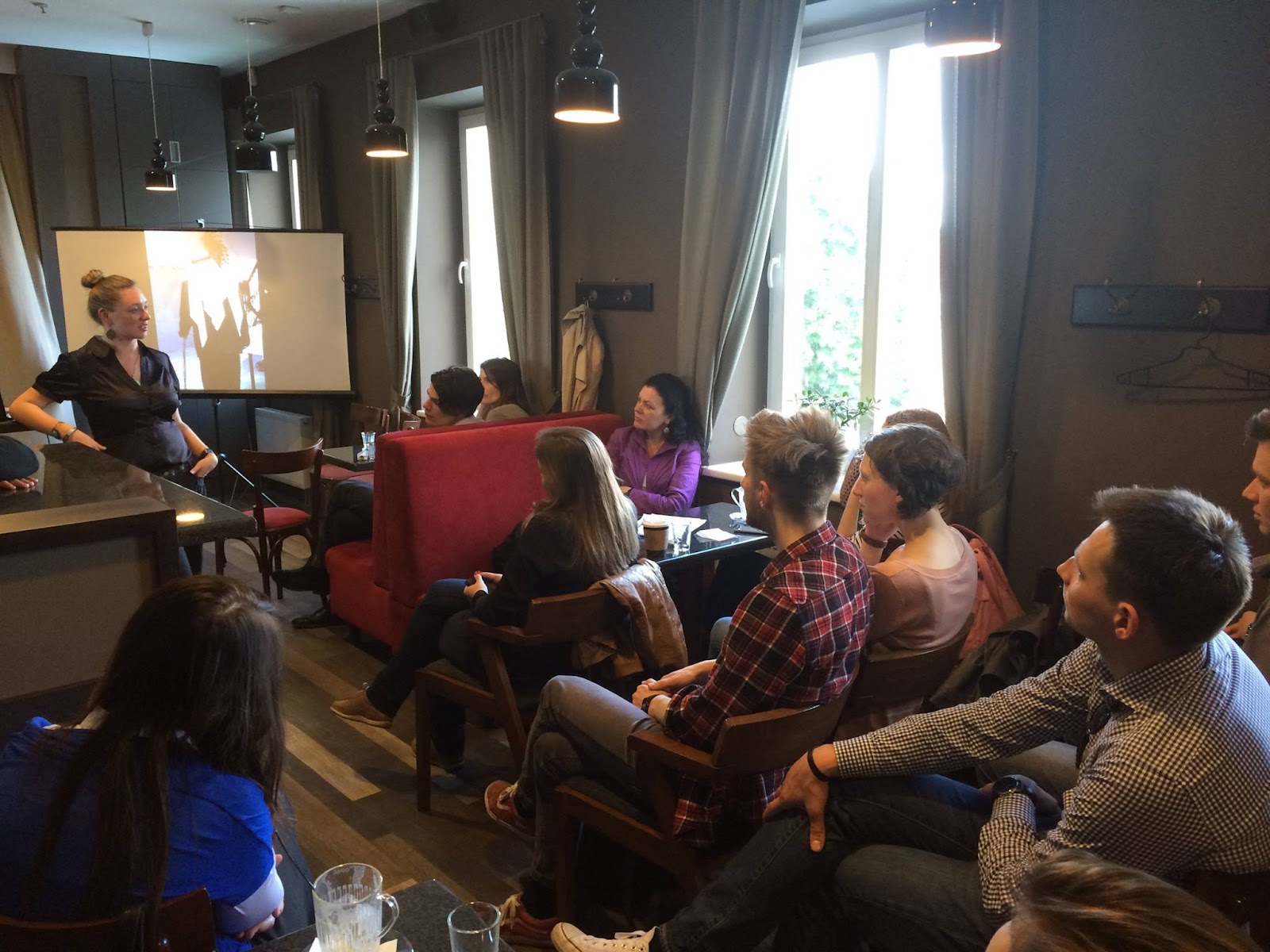
There were two roundtables organized with journalists and activists in the field of development cooperation in the following period.

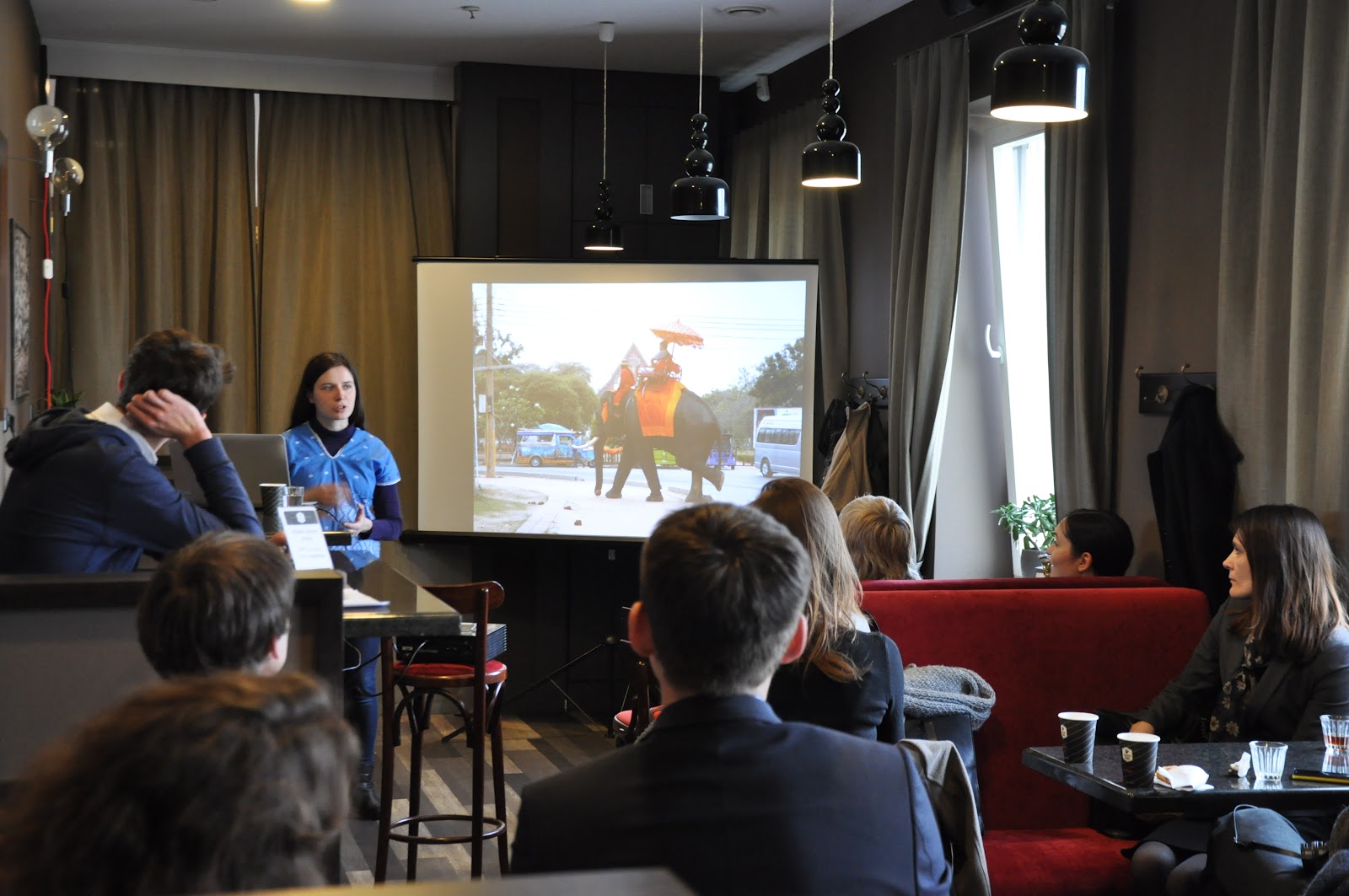
First roundtable took place in April and targeted life in Thailand. Journalist as well as expert of Asia Daiva Repečkaitė shared her experiences from visiting Thailand and spoke about peoples’ daily life as well as ways to make a living there. The country is frequently called as “land of smiley faces” and the roundtable aimed to explore what is really behind these smiles.

DSC_0006.JPG
                                     A Roundtable with Journalists and Activists, 28 April 2016

Another roundtable was organized in May and challenged views about frozen Israeli-Palestinian conflict. An activist working in the field of development cooperation in Palestine Gabrielė Tervydytė shared her experience while making a short documentary in West Bank and presented Palestinian position on the the prolonged conflict. Participants actively discussed challenges and possibilities people face in this hostile context.

gabriele-susitikimo foto.jpg
                                      A Roundtable with Journalists and Activists, 19 May 2016

Film screenings

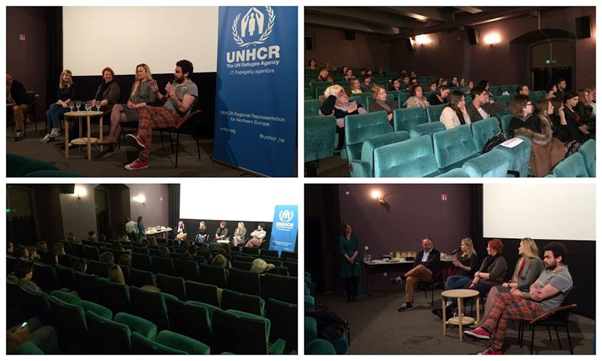
In the begining of May, in cooperation with the regional office of the United Nations Refugee Agency in Vilnius, a public screening of the  documentary “In an Alien Land” and a panel discussion in connection with the recent outbreak of the refugee crisis, reasons behind it and its outcomes was organised at the “Pasaka” cinema theatre in Vilnius.
Renata Kuleš (the head of United Nations Refugee Agency in Vilnius), Edvardas Špokas, Miglė Gaižiūtė, Eglė Marija Želvytė (LRT film crew) and a researcher of migration Karolis Žibas took part in the discussion moderated by a journalist Rosita Garškaitė.
The event was attended by more than 60 people. Audience took part in a lively debate with the film crew and experts and continued their exchange in an unofficial setting afterwards.


Open film screening at “Pasaka” cinema theatre, 
5 May 2016.


A second screening and a discussion about hope and despair people express while trapped in an “alien land” followed in the second part of May. “House of Europe” representatives introduced NGO community from Lithuanian Network of Anna Lindh Foundation with the film and its development process. Around 10 people attended the session.

 
Film screening at the meeting of Anna Lindh Foundation Lithuanian Network, 18 May 2016

African Days

In collaboration with Lithuanian Foreign Affairs ministry and several NGOs, International Day of Africa was celebrated in Vilnius and Kaunas on May 28. “House of Europe” took over a tradition of Subsacharan Africa cultural festival, formaly organized by other NGO, and prepared 4 day program. “African days” served as an umbrella for various events: African dance and drumming workshops, concert with the musicians from Africa,, meetings and discussions. Partners “Afri Ko” organized a discusion on Informational and communcational technologies and it’s influence on African development. The guest speakers from several African countries spoke in the panel. Event took place in Foreign Affairs Ministry. 

In Vilnius’ “Green Cafe” academics, journalists, volunteers presented their African experiences and specific topics in the world cafe principal. Around 35 people participated in the event. Giedrė Birzyte, a member of the project, presented her Kenyan trip. She also did the presentation in Kaunas Cultural Center of Various Nations. Approximately, audience was around 45 people.

Afrikos dienos.jpg
World cafe discussions, African days in Vilnius, May 26, 2016

Photo exhibition

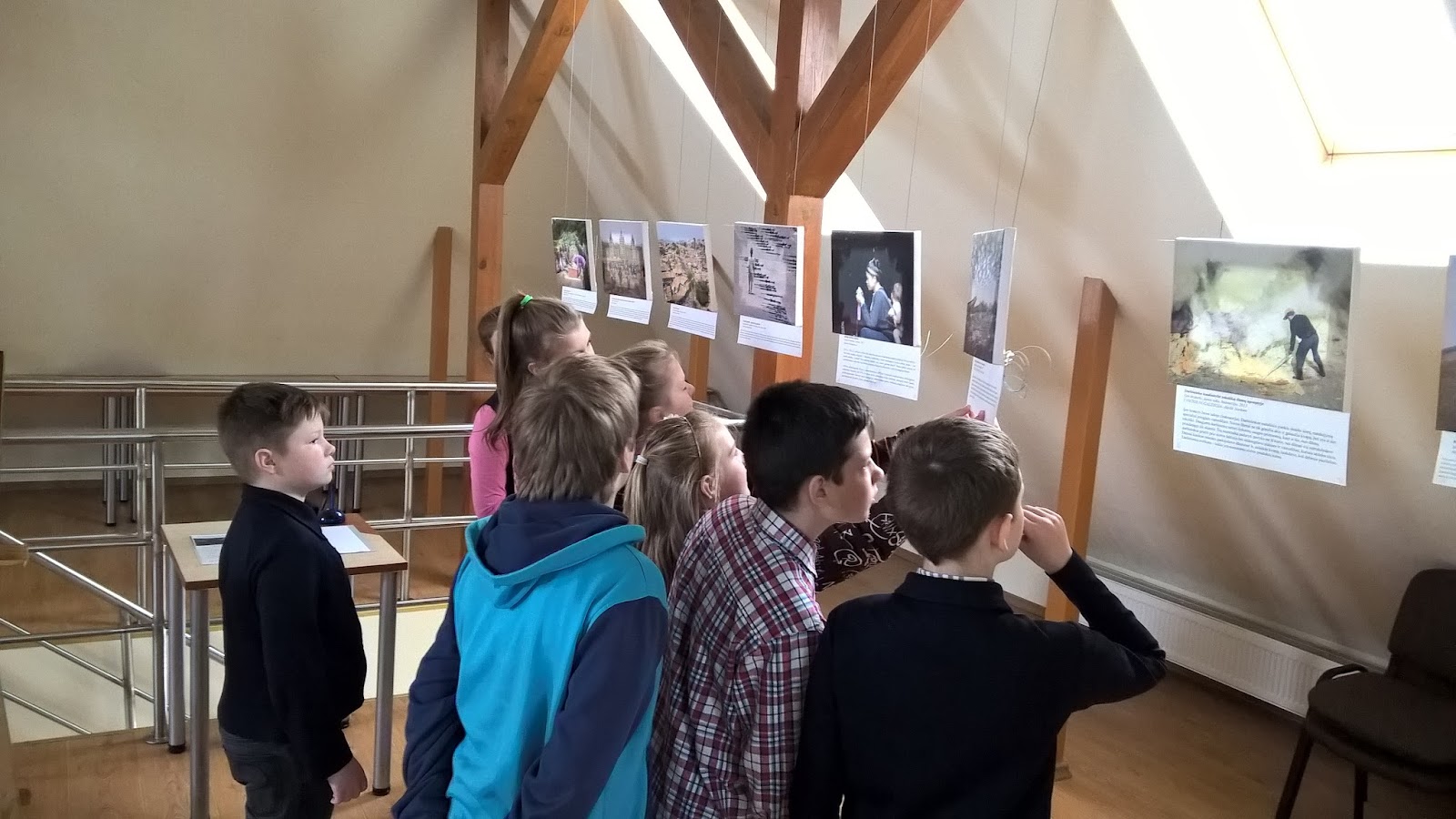
The photo exhibition “The World As You See It” continues to be displayed in different venues and invites local communities to take a deeper look into life of developing countries. In April, exhibition was displayed in Education Development Centre and Proffesional training centre of Žirmūnai. In May, it stayed in the public library of Šilutė. Further, the exhibition will be displayed in the Parliament as well as Government’s facilities and will visit smaller towns around Lithuania.
WP_20160518_11_42_19_Pro.jpg
Photo exhibition “The World as You See it” displayed in Šilutė.

Bulletin on Humanitarian Aid

At the end of May, an electronic bulletin on humanitarian aid was issued and sent out to policy makers and opinion leaders, in particular, members of the Parliament, public officials, politicians, journalists, representatives of NGO sector and national academia. While featuring articles of mainly local authors, this issue aims to present in-depth analysis of the latest tendencies and chronic challenges in the humanitarian aid sector:
  • Humanitarian aid given by Lithuanian citizens: main trends, directions, institutional challenges and future opportunities (prepared by Lithuanian journalist Jūratė Važgauskaitė).
  • Expert opinion about macro-level factors for the effectiveness of humanitarian aid and the need for structural reforms (prepared by Žilvinas Švedkauskas, NGO“House of Europe”).
  • World Humanitarian Summit and Lithuania’s part in it (prepared by Lithuanian journalist Rosita Garškaitė).
  • The prospects of cash transfers in humanitarian aid (a translation of a text by Paul Harvey, an expert at Overseas development institute).
  • Importance of humanitarian communication.
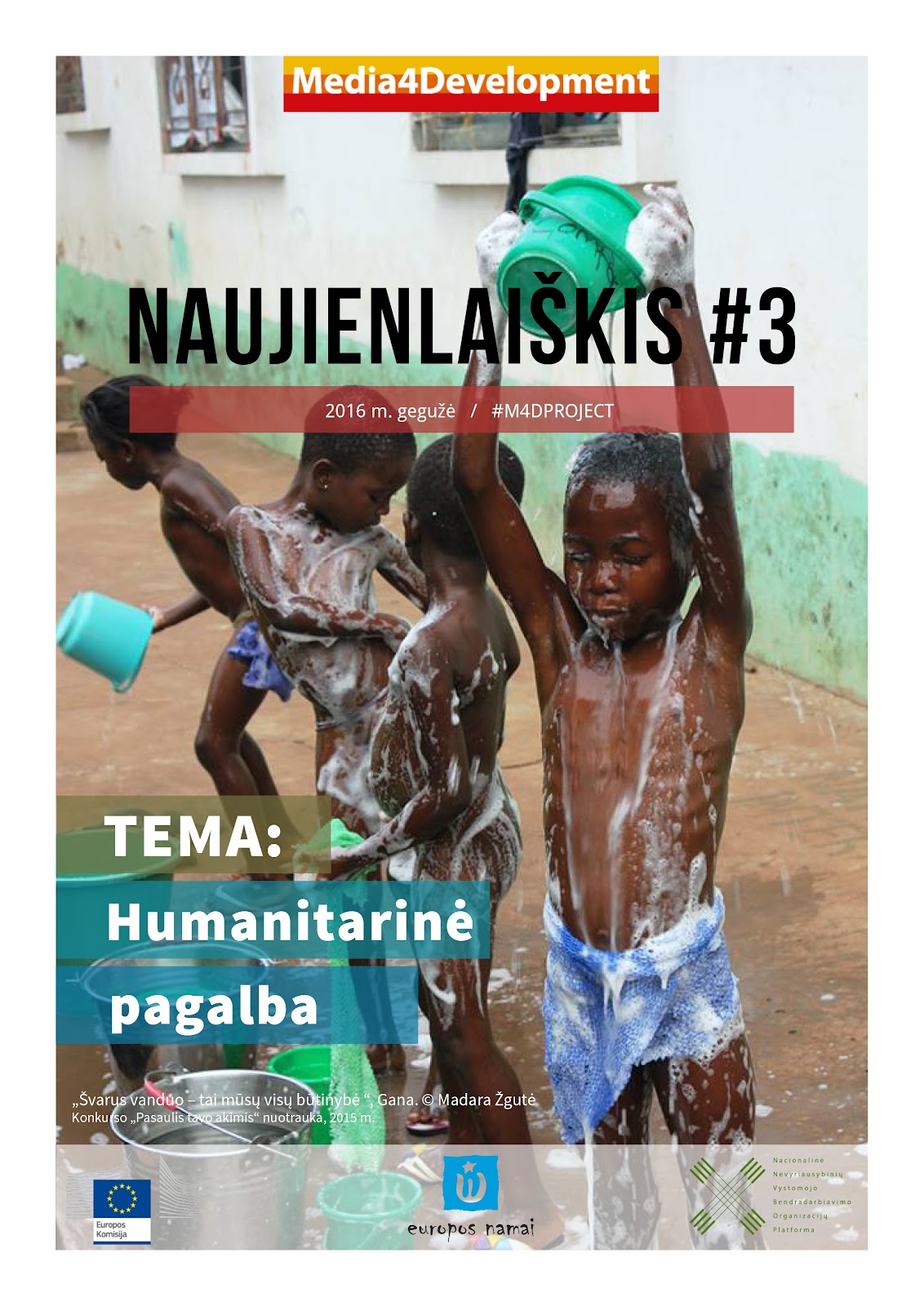
Naujienlaiskis3-paveikslelis.jpg
Cover of the Bulletin no 3.
Media appearances

On the 25th of May, “Media4Development” project was mentioned when African days idea and the program was announced on the National Broadcaster’s morning show “Labas rytas”. Project’s communication officer shortly introduced viewers to journalists’ trip to Kenya and invited to attend the meetings in Vilnius and Kaunas.

Article Section

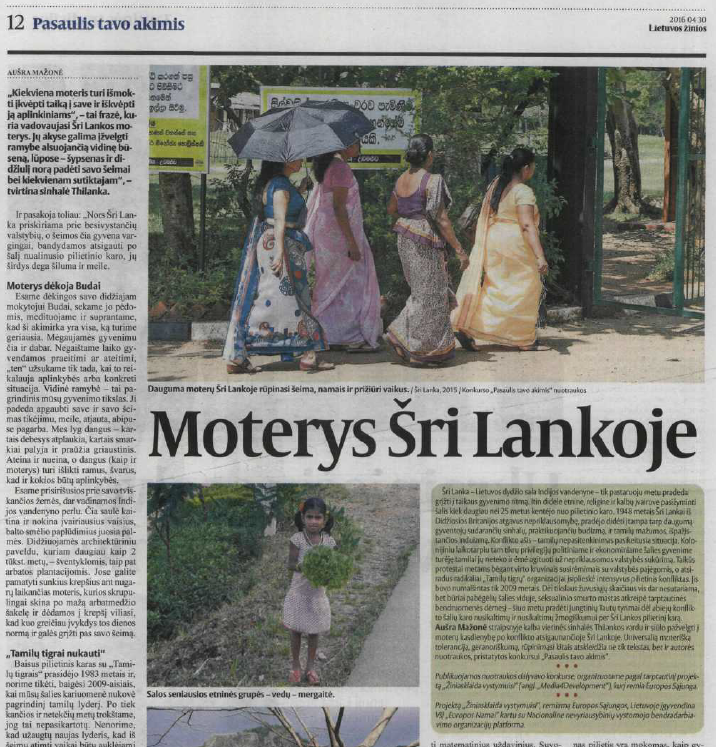
In April - May, a section in the national daily Lietuvos žinios (introduced in order to reach a wider public and familiarize it with current development issues) was further complemented by 7 different articles of various Lithuanian journalists. Traditional bee-keeping and eco-challenges for Lake Victoria in Kenya were presented by Berta Tilmantaitė, whereas Vaida Blažytė covered a conflict between man and nature in country’s nature conservancies. Besides special insights to Kenya, articles about World Humanitarian Summit, women rights in Sri Lanka and women entrepreneurs in Thailand, paradoxes of humanitarian aid in Ukraine were published. Each article is accompanied by an introduction into a certain relevant aspect of development cooperation.

 Aušra Mažonė. Women of Sri Lanka. 30 April, 2016.