Showing posts with label bulletin. Show all posts

Wednesday, 29 November 2017

PIN activities August – November 2017

Bulletin – Somalia 
In September, People in Need published the third issue of the bulletin Rozvojovka. Just recently, Czech journalist Lenka Klicperová visited Somalia and she wrote a main story for Rozvojovka about the current situation in Somalia - a country, which is still largely paralysed by al-Shabaab’s militias and by great poverty. We also interviewed Arthur F. Sniegoň, who moved from Czech city Třinec to Africa so that he could help to save elephants in Chad. Readers could also read about Czech-Ethiopian relations. Already in the 1980s, Czechoslovakia helped to build the electric power station, breweries or water wells. Ethiopian students went to Czechoslovakia to study university of life sciences or archaeology.   
Bulletins are sent to relevant decision makers, i.e. members of Czech national Parliament and Czech representatives in European Parliament, Ministries' officials and key development experts, scholars and NGO representatives. 

Media Supplement "Czech Republic helps" in Deník
On the 26th of September, People in Need published a media supplement "Czech Republic helps" in Deník, the biggest regional and the second most read newspaper in Czech republic. The supplement was published, when People in Need celebrated its 25th anniversary. It was twenty-five years ago, when a group of war journalists and volunteers came together and decided to provide help in crisis situations. This group of enthusiasts grew into an organization that has 1,800 employees working in 32 countries with a budget of 1.7 billion Czech crowns (64 million Euros). In the course of its existence, the organisation has operated in 54 countries and helped more than 18 million people.In development aid provided in 20 countries, the focus today is primarily on transferring know-how and supporting the most vulnerable people, who are learning to face up to adverse natural and social conditions and developing their ability to help themselves. The supplement was dedicated to the  development activities of People in Need from Afghanistan, Angola to Philippines.

Journalists from Aktuálně.cz in Ukraine and Cambodia
In September, journalist Ondřej Soukup from Aktuálně.cz went to Ukraine, where he visited People in Need's development projects. He wrote about the current situation in eastern Ukraine and how people are struggling to live at the front line.

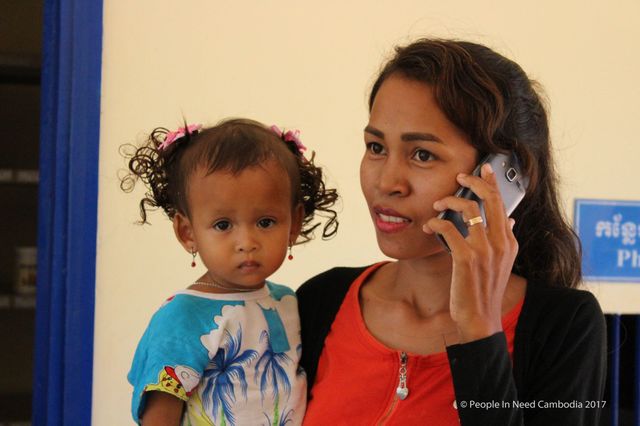
In October, journalist Simona Fendrychová from Aktuálně.cz travelled to Cambodia. In Cambodia, she visited health and livelihoods development projects of People in Need. How we fight dangerous superstitions, which harms mothers and children? Or how are local communities being trained to be better prepared for floods? The readers could find the answers in Simona's articles.

Czech TV in Moldova and Angola
In November, Linda Bartošová from Czech Tv spend a week in Moldova with People in Need. Moldova is known as the poorest country in Europe. The journalist interviewed young people about their prospects and where they see their country in the future

Dana Zlatohlávková, reporter from Czech Tv, went to the last journalist trip organised by People in Need. She visited Angola - country, which went through a historical political change this year. President Dos Santos stepped down after 38 years in power. How is the political transition going on? How is Angola responding to the influx of refugees from neighbouring DR Congo? The Czech viewers could find the answers in her stories. 


Czech Radio in Mongolia, Myanmar and Ethiopia
'Three in the world' is the name of Czech Radio audio-documentary series. Jiří Slavičínský in Mongolia, Brit Jensen in Myanmar and Ivan Studený in Ethiopia spend a week with local families. Each one shot an audio documentary on different topic. In Mongolia, Jiří focused on the preparation for dzud, Brit covered the issue of child abuse in Myanmar and Ivan experienced how is it like to live with a scarce water in Ethiopia. An hour long documentaries will be broadcast in December and in the beginning of 2018 on all Czech Radio's stations.  


Media analysis: Media coverage of developing countries and Czech development cooperation in 2015 and 2016
In November, PIN published a media analysis written by Sandra Štefaniková from Charles University in Prague. The analysis focused on media coverage of developing countries and development cooperation in Czech media between 2015 and 2016 and the comparison with the media analysis of 2013 and 2014 (link here). The results show that Czech media cover the topic mostly in the daily news - so called hard news. The news accounted for 76% of the analysed data. The analysed topic was mostly to be found in the online media, less in the print media and minimally in radio or television. In comparison to the previous years, the increase of online media coverage is significant. 

Thursday, 3 August 2017

PIN activities May – July 2017

Bulletin – Climate Change

In July, People in Need published the second issue of the regular bulletin Rozvojovka. Main story was the impact of climate change in Philippines and the possible mitigation strategies. We interviewed Monika Nová, co founder of health clinic in Malawi, to find out, why still so many people disbelieve “the modern medicine” and prefer to go to traditional healers. Readers could also read about, how skating in Myanmar has become one of the symbol of democracy, or about modern slavery. David Lachout from African Information Portal wrote an analysis inquiring the issue of corruption in Africa. Bulletins are sent to relevant decision makers, i.e. members of Czech national Parliament and Czech representatives in European Parliament, Ministries' officials and key development experts, scholars and NGO representatives.


Journalists from Aktuálně.cz in Iraq

In April, a journalist Martin Novák and photographer Jakub Plíhal travelled to Iraq to visit People in Need’s projects. They have published several stories, videos and photo reportages about the life in liberated Mosul

Czech Tv in Philippines, Jordan, Iraq

Barbora Šámalová, Czech Tv correspondent for China visited People in Need’s Country program in Philippines. She produced several stories for the main news about the issues of poverty or urban development. She also made a short documentary “Life in Storm” about the livelihoods’ recovery after typhoon Yolanda and about People in Need’s development projects.


In May, Jakub Szántó, Czech Tv correspondent for Middle East, went to journalist trip in Jordan, where he visited Czech government’s project MEDEVAC and other humanitarian projects that help refugees in the country.
In June, Jakub Szántó went to Mosul in Iraq, where he was shooting in the liberated part of the city. He produced stories about the level of destruction, captured Daesh’s prisoners, the renovation of historical sites or return of refugees to their city, which were broadcasted in the Czech Tv's main news program.

Study trip with politicians to Philippines

From May 28th to June 3rd, in total 5 members of parliament travelled to Philippines with People in Need. The participants were from Czech Republic, Slovakia, Lithuania, Latvia and Estonia. The goal of the joint study trip was to introduce these parliamentarians to the mechanisms of development cooperation’s implementation, monitoring, evaluation and how it should be based on country and community needs. We hope the parliamentarians developed an appreciation for the benefits of the development cooperation for their own countries, which are currently allocating their ODA primarily to middle income countries and only Czech Republic and Slovakia are the members of OECD Development Assistance Committee, which constitutes the leading international forum for bilateral providers of development co-operation.
The participants had the opportunity to visit the development projects and to meet national and international development implementers and officials in Metro Manila and in Eastern Samar. In Manila, they met with senators and congressmen and with local NGOs' representatives, they visited vice-president's office. In Eastern Samar, the parliamentarians visited the agricultural projects' of Czech caritas and People in Need. They were also welcomed by local vice-governor. 

Wednesday, 4 January 2017

Green Liberty: Fourth Six Months of M4D

Opinion Pool


Latvian society is very poorly informed about sustainable global development. Space of people’s thoughts and activities is limited to national scale, and the world in their perception is fragmented.  Latvian inhabitants consider that Latvia in comparison with other countries is much poor than it is in reality. About poor conditions people blame country and international structures, and do not take responsibility on them. Majority of society is not ready for any practical action to support global development, and their active civil position is weak: responsibility and involvement are not priorities. Lack of awareness about development processes in the world encourages formation of false assumptions about global development that creates formation of different misconceptions and social myths.

These are some of the general conclusions based on the opinion pool “Sustainable global development: Awareness and action of Latvian society” (Līdzsvarota globālā attīstība: Latvijas sabiedrības informētība un rīcība) that we implemented in collaboration with the marketing and public opinion research centre SKDS.

Data have been obtained from Latvian residents in the survey through direct interviews. Fieldwork was on April 9, 2016 to April 20 and from May 21 to June 1. With stratified random sampling method in whole country 1,005 respondents aged 18 to 74 years have been surveyed. Respondents’ sample represents a larger population. Study statistical error does not exceed the total responses distributions + / - 3% limit.

Detailed description of the results of this survey is published in the information bulletin Development Cooperation News 4th issue “Global Development Myths”. 


International conference Bratislava Roundtable 


Bratislava Roundtable conference “Sustainable Development Goals - Opportunities and Challenges” was organised by the Slovak NGDO Platform under the auspice of the Slovak Presidency in the Council of the European Union and took place in Bratislava on September 5th 2016. 

Among around 60 participants, including policy makers, media representatives, civil society representatives, private sector representatives and academics from the Czech Republic, Estonia, Finland, Lithuania, Slovakia,  United Kingdome and other countries were seven participants who represented Green Liberty: Inese Vaivare, Director of Latvian Platform for Development cooperation (LAPAS), Madara Siliņa, Third Secretary of Development Cooperation Policy Division at the Ministry of Foreign Affairs of the Republic of Latvia, Māra Sīmane, Adviser of Cross-Sectoral Coordination Centre, Sanita Kalnača, Adviser of Cross-Sectoral Coordination Centre, Āris Ādlers, Board Member of Latvian Green Movement / CEE Bankwatch, Līva Stade, Green Liberty and Inga Belousa, Green Liberty.

This was the second international conference as one of the activities of the project Media for Development. The first conference - Riga Roundtable “Financing for Development: Role of EU Member States” was organized by Green Liberty, Latvian Green Movement and Ministry of Foreign Affairs of the Republic of Latvia in Riga on June 11-12, 2015. 


Joint Study Trip to Nepal


Two journalists, Santa Logina from regional newspaper Zemgales Ziņas and Iveta Sondore from the magazine Vides Vēstis represented Green Liberty in the joint study trip to Nepal on the September 4-11, 2016. 


This study trip was organized by project’s Finnish partner organization VIKES. During the trip Santa Logina and Iveta Sondore together with her colleagues from other M4D partner organizations – Estonia, Lithuania, Czech Republic and Slovakia met with CIJ staff, Nepali editors, NGO actors, journalists, editors, European actors (including Nordic Embassy representatives) in the country, local community and local authorities in their visits to Kathmandu, Sindhupalchowk and Dolakha districts.


Reflections on situations and experience have been published in several proceeding articles and are available here: 


Focusgroup discussion about global education 


In November 4 we organized a focusgroup discussion about global education and global citizenship. To share their experience we invited 10 different stakeholders of global education:
  1. Liene Baltmane, teacher of English at Mārupe Secondary school – represents teachers who implement global education at school;
  2. Edgars Bērziņš, teacher of history and development projects at Andreja Upīša Skrīveri Secondary school  – represents teachers who implement global education at school;
  3. Ilze Dalbiņa, coordinator of UNESCO Associated School project and Education department – represents UNESCO LNK;
  4. Ligita Grigule, head of the Practice and global partnership centre of Faculty of Education, Psychology and Art at Latvia University – represents higher education and academic sector that provides teacher education;  
  5. Valters Kinna, Green Liberty – represents non-governmental sector that implements projects and teacher education courses and seminars;
  6. Zane Oliņa, National Centre for Education – represents project “Competence based approach in education curriculum” at the National Centre for Education;
  7. Elita Opincāne, expert of education and life-long learning of Education department at Rēzekne municipality represents municipalities that implement global education projects;
  8. Sintija Šmite, head of international cooperation programs department at State Education Development Agency represents State Education Development Agency;
  9. Līva Šteinberga, senior referent of Development cooperation policy department at the Ministry of Foreign Affairs of the Republic of Latvia – represents Ministry of Foreign Affairs of the Republic of Latvia;
  10. Iveta Vērse, head of the Education development centre – represents non-governmental sector that implements projects and teacher education courses and seminars. 

Global education week in Latvia this year was organized in November 1 – 12. It was coordinated by the Latvian Platform of Development Cooperation (LAPAS) in collaboration with Green Liberty, UNESCO Latvian National Commission, Faculty of Education, Psychology and Art at Latvia University, Latvian Association for Cooperation in Education (LACE), and other civil society organizations. This year’s GEW motto in Latvia – what you sow, that you reap – highlights that active participation is the way how we all together can shape our community, country and development of the planet.

The focusgroup discussion about global education was organized during the Global Education Week (GEW) that is a Europe-wide awareness-raising event that takes place annually in formal and non-formal educational settings across the continent. The GEW’s aim is to encourage educators and learners to explore educational activities for global citizenship. The GEW addresses issues related to diversity and inequality at the local and global levels, and tries to foster: awareness of the wider world and of our own role as world citizens, attitudes of respect for diversity and intercultural communication skills, responsibility for our own actions, and the ability to take action to make the world a more equitable and sustainable place.


TV/Movie Producers’ Meeting in Finland


Five producers: Elizabete Palasiosa from Juris Podnieks Studio, Zane Kalnina and Laura Cīrule from film studio "Woodpecker Pictures", Ieva Goba from Elm Media, and Danuta Juste from TVNET represented Green Liberty and took part in the TV and movie producers’ meeting in Helsinki and Tampere on November 10-11, 2016.

The producers’ meeting was organized by project’s Finnish partner organization VIKES. Its focus was several meetings (with representatives of the Finnish Film Foundation, Yle Red Nose Day Show Producers, Tampere International Film Festival Executive Director Juhani Alanen, journalist and director Laura Satimus from the Finnish Broadcasting Company YLE, Yle producer and development reporter Pasi Toivonen), networking and participating in the Yle Red Nose Day Show.

For representatives of Green Liberty this meeting was a great success, especially discussions and experience exchange with producers from Gimmeyawallet Production, Docventures, Madventures and Soundtracker about changing the way of watching documentary films. The GL representatives shared that it was inspiring to observe five hours long the Yle Red Nose Day Show online that had been prepared during the whole year. They expressed their initiative to cooperate with Green Liberty in order to organize similar campaigns in Latvia. Also, the GL representatives were challenged to think about the role of public TV, its competitiveness with commercial channels, and possibilities to attract youth as target audience. Their reflections were directed to communicating meaningful content in an attractive way not losing its value. 


Fair Trade day: What is the real price of sports equipment?


Sports equipment – clothes and accessories – is essential element of sport. The quality of sports equipment significantly influences our wellbeing when we take a part in sports activities and achieve results. But what do we mean by the quality of sports equipment? Those who have been interested to find answers on questions – how fair is sports equipment and what is its real price and impact – participated in the Fair Trade day organized in the Latvia Academy of Sport Education (LASE) on November 10, 2016.

This event invited different stakeholders connected to reflect on how the local and the global contexts are integrated in sport, to clarify the real price of t-shirt, to participate in focusgroup discussion about fairness of sports equipment, to watch two short documentaries about industry of Nike goods and production of football balls in Pakistan, and to discuss about sport and sustainable development.

More info about the event here.


E-bulletin “Development Cooperation News”


To enrich awareness of society and policymakers in Latvia about global interconnection, challenges and initiatives to solve them both globally and locally we publish electronic information bulletin Development Cooperation News (DCN).

The 4th issue is Global Development Myths is looking for answers on the following questions: Is it truth or not that “we should not help other countries, because we ourselves are poor”, “poverty results from too high birth rate”, “help makes a receiver to become lazy”, “financial assistance is the most needed help for poor countries”, “climate change is not connected to increase of poverty”? Stories that provide different answers on these questions are published in five sections – POSITIONS, EVENTS, EXPERIENCE, OPINIONS, and RESOURCES that shape the structure of DCN.

DCN is published electronically twice a year and features current development cooperation topics from the perspective of practitioners, opinion leaders and policy-makers.


Read and download the bulletin Development Cooperation News
 here


Tuesday, 20 December 2016

Bulletin - Afghanistan between life and death

In December, PIN published its fourth issue of bulletin. We decided to dedicated the last issue of this year to Afghanistan. Tereza Engelová, Czech journalist, visited Afghanistan in November and she wrote for Rozvojovka an exclusive story about the current situation in Afghanistan. Also we interviewed PIN's colleague Jiří Bednář, who left a high prestige job in a consulting firm and has started to work in Myanmar. We published an analysis about Saudi Arabia's controversial development aid, a story about human trafficking in Nepal or a story about the impact of the banana business. Czech ambassador in Moldova Zdeněk Krejčí answer our question: "Why do we send the development aid to lower middle income countries?". Bulletins are sent to relevant decision makers, i.e. members of Czech national Parliament and Czech representatives in European Parliament, Ministries' officials and key development experts, scholars and NGO representatives.

Wednesday, 10 August 2016

Green Liberty: The Third Six Months of M4D

E-bulletin “Development Cooperation News” 
To enrich awareness of society and policymakers in Latvia about global interconnection, challenges and initiatives to solve them both globally and locally we have started to publish electronic information bulletin Development Cooperation News (DCN).
DCN is published electronically twice a year and features current development cooperation topics from the perspective of practitioners, opinion leaders and policy-makers.
The 3rd issue is Sustainable Development Goals. It is looking for answers on the following questions: How can we reduce global poverty, inequality, injustice, and climate change by empowering development of our local communities? This global and local news is published in five sections – POSITIONS, EVENTS, EXPERIENCE, OPINIONS, and RESOURCES that shape the structure of DCN.
Read and download the bulletin Development Cooperation News here.
The next – 4th issue of Development Cooperation News will be on how to measure Sustainable Development Goals

Joint Study Trip to Palestine 

A journalist from regional newspaper Zemgales Ziņas - Agnese Leiburga represented Green Liberty the joint study trip to Palestine on the July 11-17. This study trip was organized by project’s Finnish partner organization VIKES. During the trip Agnese Leiburga together with her colleagues from other M4D partner organizations – Estonia, Lithuania, Latvia, Czech Republic and Slovakia visited Bethlehem, Beit Sahour, Palestinian refugee camp Aida in Bethlehem, Hebron, Jerusalem, and Abu Dis – city, which has been cut away from Jerusalem by the Israeli separation wall. During these visits there was a chance to interview Bashir and Jeanette who are well-traveled Palestinian-Christian couple and have decided to live in Bethlehem, as well as Palestinian family affected by the separation wall, to visit Bethlehem University with the participants of the media camp and much more.
Reflections on situations and experience have been published in several proceeding articles and are available here:
Leiburga, Agnese, (July-August, 2016). Viena žoga divas puses – Izraēla un Palestīna. [Two sides of the same fence: Israel and Palestine]. Zemgales Ziņas [regional newspaper Zemgale News],
- August 11, 2016:

Helsinki Intensive Course “Reporting World News” for Journalists 

On April 20-22 three Latvian writing journalists who have recently started their career together with their colleagues from other M4D partner organizations – Estonia, Lithuania, Latvia, Czech Republic and Slovakia – deepened their awareness and understanding about reflecting on global development issues in an Intensive Course on Development for Journalists in Helsinki. Green Liberty was represented by Iveta Sondore (Vides Vēstis), Anna Ūdre (FEJS Latvija) and Santa Logina (regional newspaper Zemgales Ziņas). The intensive course was organized by project’s Finnish partner organization VIKES. The focus of the course was on such topics as timely media issues in global context, sustainable development, natural resources and disasters, migration and war coverage. The seminar was a great success because of its relevant content, discussions and workshops, organization and atmosphere.

Photo and Story Competition Winners’ Trip to Kenya 

From February 28 till March 23 a group of two people representing Green Liberty had a possibility to explore Kenya and challenge our stereotypes on life in East Africa. Lasma Ozola was interested in sustainable agriculture practices in Kenya. Liene Bieza – a photographer – captured group’s moves during the travel. Also, Liene Bieza and Lasma Ozola were the winners of the photo/story competition Decent Life for All. Lasma and Liene were accompanied by Dimitri Vanham from Belgium who was documenting interviews with project developers in video.
During three weeks they travelled through different regions of Kenya to see Laikipia Permaculture Project, Sustainable Village Resources Organic Coffee project in Rongo, Regenerating Rusinga Project, Drylands Natural Resource Centre Reforestation project in Makueni. Read the reflections in the article Environment, agriculture, community and education in Kenya: Reflections from Green Liberty

Evening Tea with Documentary Journalists 

On the February 17th Kārlis Lesiņš and Lelde Prūse, journalists from the Woodpecker Pictures were invited to an evening tea with Green Liberty’s staff and friends to share the story of their trip to Rwanda and the Democratic Republic of Congo (DRC) where they filmed a documentary movie about the care for protected eastern gorillas (Gorilla beringei beringei andGorilla beringei graueri).
Read the reflections about the event here: Evening tea with documentary journalists

Social Campaign

With a successful piloting in the knowledge festival HELSUS on May 21st in Jelgava we have started a social campaign “Myths and truths about our participation in global development”. The overall address of this social campaign to general public in Latvia is incorporated in the question: Does it seem to you that “we should not help other countries, because we ourselves are poor”, that “poverty results from too high birth rate”, that “help makes a receiver to become lazy”, that “financial assistance is the most needed help for poor countries”, that “climate change is not connected to increase of poverty”? If yes, come and find it out if it is truth or not. Participants interested in finding this out were involved in discussions where they shared their opinions about poverty, birthrate, and impact of rich and poor countries and whether help changes the situation for good or bad. 
The second public debate was during the conversation festival LAMPA on July 1st in Cēsis where we added the next step to our discussion: How to substitute our myths with a rather constructive view on reality?  And why transforming myths to truths is similar to swinging on a swing? The discussion was organized in the LAPAS (Latvian Platform for Development Cooperation) tent that hosted several other discussions, conversations, films, and games about global development organized by NGOs that shared similar vision in the need to lend a hand to make the world a better place.  

Before the campaign we organized an opinion pool that helped us to choose five the most popular myths in Latvia:
    - we should not help other countries, because we ourselves are poor,
     - poverty results from too high birth rate,
     - help makes a receiver to become lazy,
    - financial assistance is the most needed help for poor countries,
    - climate change is not connected to increase of poverty.
We started our discussion with a metaphor of swinging on a swing, and connected it to the process of changing myths to truths. After discussing each myth we shared the relevant results from the opinion pool. Several of proceeding events of the social campaign will be organized in the 2nd part of this year.
Reflections and pictures from piloting the campaign in Helsus: http://www.zalabriviba.lv/par-globalizaciju/tiekamies-sarunu-festivala-lampa/

Photo Exhibition “Decent Life for All”

Green Liberty also organizes a nation-wide photo exhibition Decent Life to All that is ongoing and includes 24 pictures from the photo competition organized in July – September 2015. The pictures included in the exhibition are created by professional and amateur photographers from Estonia, Lithuania, Latvia and Slovakia. Among pictures representing Latvia several of them are created by national winner Liene BiezāThis exhibition provides the visitors an opportunity to think about their daily habits and the world as our global home, and to enhance their understanding of development issues. 
Since its opening at the European Union House in Riga the photo exhibition has been hosted by Latvia University, Latvia University of Agriculture, LU Botanical garden, Gulbene Municipality, Olympic center in Riga, Riga Central Market, shopping centre Galerija Centrs, Latvian National Library restaurant and several other famous restaurants, etc.
The exhibition aims to address general public in Latvia starting from school youngsters to elderly people. By choosing popular and diverse exhibition places we are trying to reach people of different professions and interests. In Gulbene the exhibition was used as a tool for teachers to work with pupils and it helped as educational material in local community.


Regional Journalist Training

Our collaboration with regional newspaper Zemgales Ziņas (Zemgale News) initiated co-organization of regional journalist training Global echoes in regional journalistic that was held on March 11 in Jelgava. The aim of the training was to discuss urgent global issues in the field of journalism, to look for answers about the role of regional journalism in a globalized world, and to enjoy a fair-trade coffee and tea. 
The program implied discussions about the mentioned issues and personal experience stories told by a journalist Kārlis Lesiņš from Woodpecker Pictures who shared the story of his trips to several countries of Global South, including Rwanda and the Democratic Republic of Congo (DRC). 

The training gathered 12 participants who highlighted that events like this provided for regional media are very rare. They shared that this and similar events help to open mind, encourage journalists to look at local activities from a global perspective and at global issues from a local perspective, and to cooperate with each other. Several journalists pointed out that this training confirmed that it is crucial to bring topicalities of a European project to the level of local community.  
Concluding ideas that reflect the issues and reflections covered in the training can be summarized as follows:
Regional journalism has a significant educative purpose, especially in local regional communities where the majority of population do not belong to formal educational system anymore. Thus, local and regional printed media are crucial means of informing and awareness rising for a local community. And this purpose is closely connected to the issue of responsibility.
A journalist is like a woodpecker that hammers persistently until she or he gets to the essence. It is not a routine activity, as a journalist should sustain his or her researcher’s spirit by moving around, observing, gathering information, meeting people and creating stories about fresh issues. Yet, in this activity a balance between expectations from employers and media consumers, available information and resources, and journalist’s own interest and passion should be ensured. A journalist most likely cannot change all the global problems, but what she or he can do is to create stories that can serve the aim to raise awareness and inspire to build hopeful future.
An added value of a story is a presence of journalist’s own culture (ethnic, gender, age, social and economic position, etc.) and its dialogue with the story.