Showing posts with label ERR. Show all posts

Monday, 25 December 2017

The documentary “Sparkling Rivers” in the festivals

ERR film Sparkling Rivers, writer Anna Gavronski, director Märten Vaher and cinematographer Meelis Kadastik, was selected to the official programme of Barcelona International Environmental Film Festival FICMA. It was 24th time the festival took place, which makes it the oldest environmental film festival in the world.  


We arrived in Barcelona on 7th of November. First news we got form the organisers were a bit concerning- they said that there is a chance that our film screening might be cancelled due to general strike. Fortunately, just after they had warned us, they received a phone call, that our film will be still shown on the big screen. We were very happy and thankful for the organisers for managing to preserve the screening. Besides that we went to meet the other filmmakers at the evening in the cinema and watched some short animation films.
pan> was selected to the official programme of Barcelona International Environmental Film Festival FICMA. It was 24th time the festival took place, which makes it the oldest environmental film festival in the world.  


The second day of our trip was a big day for us, because it was a day, when our film was screened. As it was on the same day as the general strike, we went to watch the protests during lunchtime. Later we heard that other filmmakers did the same. I think curiosity is embedded to all documentary filmmakers. In the evening, we watched some other films and then our film Sparkling Rivers was shown. After the screening people asked questions and it was interesting to see that our film moved people even though it was filmed in Georgia by Estonian filmmakers.

On our third day, we had filmmakers’ lunch, where we met a lot of people. It was a good place for changing contacts. To our surprise one of the crewmembers of Swedish film came to speak with us in fluent Estonian. It turned out that both of his parents were from Estonia that they thought him the language. After the lunch we went to watch the Swedish film, which was about soil.


In the evening we went to the festival closing event, which took place at a very nice natural science museum.


To our big surprise Sparkling Rivers won the award for the best short documentary, it was a great honour and made us very happy.

Besides Barcelona our film Sparkling Rivers was shown in October at the SunChild International Environmental Festival in Yerevan, Armenia. The festival is the first and only of its kind in the South Caucasus region. Our film was one of the 83 films chosen for the official section, it was selected from 1214 submitted films.

Premiere of the documentary “Sparkling Rivers”

ERR together with Mondo and the film-makers writer Anna Gavronski, director Märten Vaher  and cinematographer Meelis Kadastik organised public screening to the documentary.


On 7nd February 2017 the documentary “Sparkling Rivers” was premiered in Kinomaja cinema in Tallinn with 75 viewers.


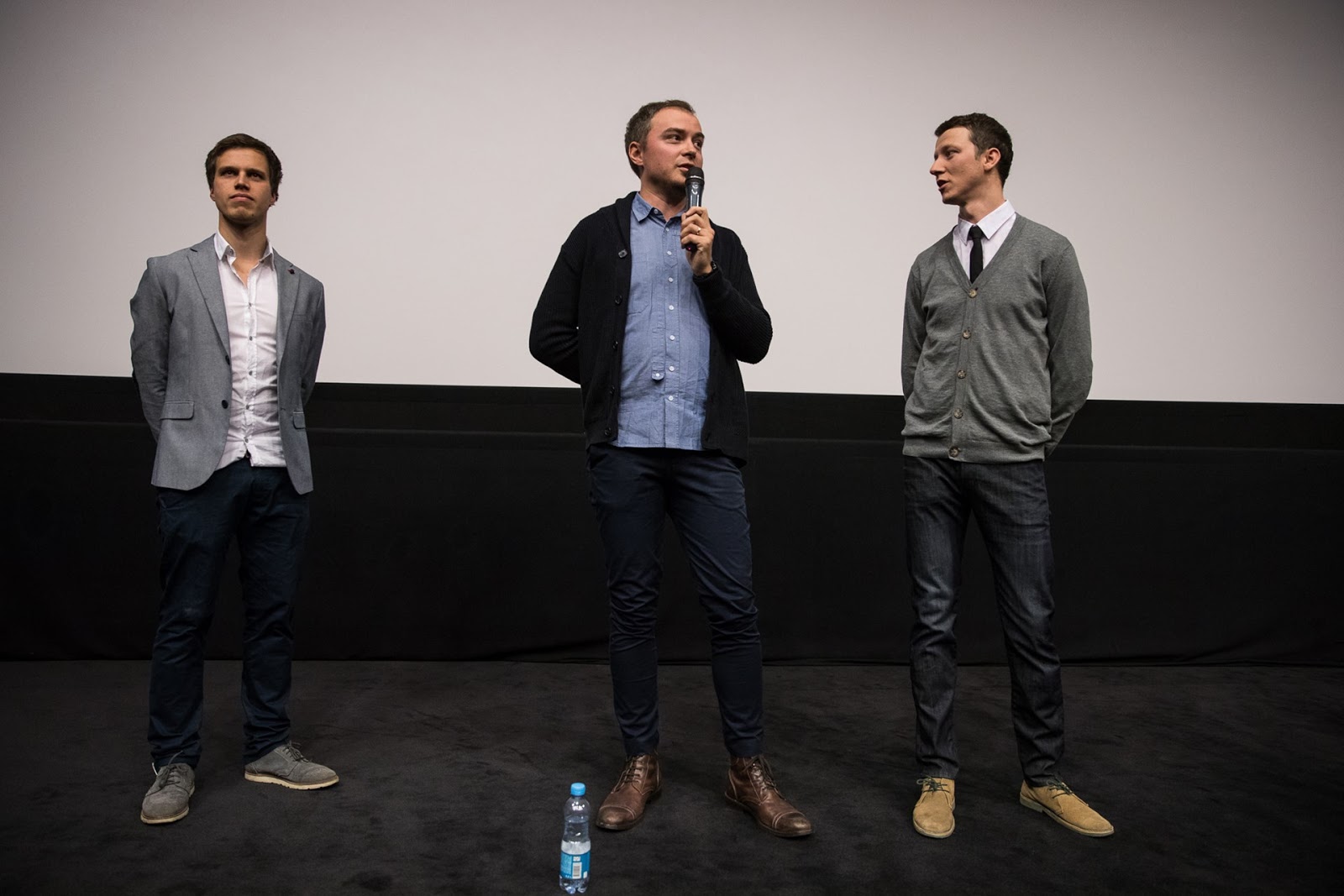
 The Estonian Green Movement project coordinator Mihkel Annus speaks.


On the right: Estonian Green Movement project coordinator Mihkel Annus, author of film “Sparkling Rivers” Anna Gavronski, Estonian Roundtable for Development Cooperation renewable energy specialist Sigrid Solnik, Eesti Energia renewable energy specialist Innar Kaasik and neighbour of the biggest hydro in Estonia Margus Teemant. 

Briefly about the film.

Georgia is not only a country of wine and high mountains, but it has also more than 25.000 rivers. Running water is a richness that has been noticed by a lot of investors and made Georgia their desired destination. Even now 80 per cent of Georgian electricity comes from hydroelectricity power plants and in the near future there are plans to construct more than 100 new stations. For thousands of people it means they have to be resettled. Shady deals, unclear investors registered in tax havens, energy minister’s business interests in the hydro construction company and deaths by landslides during construction of one large hydro. Is that a fair price for Georgian people have to pay? Environmental activist Dato Chipashvili fights against these hundred million investment projects putting the interests of local people and transparency first.


After five-hour drive from Tbilisi we arrived at the Enguri dam, the world’s second highest dam of its kind. We were stunned, the concrete arch was gigantic, its height is 271.5 meters.


Our guide Dato Chipashvili from an NGO called Green Alternative explained, how in his opinion the old dam could be made more effective.


The European Bank for Reconstruction and Development has agreed to provide US$200 million for Georgia's 280-MW Nenskra hydropower plant. On the other hand, people from Nakra village are afraid that their homes will be flushed away by a mud river.


We had been asking for an interview with the minister of energy Kakha Kaladze.

The film Sparkling Rivers was selected to the official programme of Barcelona International Environmental Film Festival FICMA and won the award for the best short documentary.

Besides Barcelona our film Sparkling Rivers was shown in October at the SunChild International Environmental Festival in Yerevan, Armenia. The festival is the first and only of its kind in the South Caucasus region. Our film was one of the 83 films chosen for the official section, it was selected from 1214 submitted films.

Sunday, 15 January 2017

Premiere of the documentary “Three Jewels”

ERR together with Mondo and the writer-director Gerli Nõmm organised public screening to the documentary. 


On 22nd November 2016 the documentary “Three Jewels” was premiered in Kinomaja cinema in Tallinn with 55 viewers.


Sound director Indrek Soe, translator Nguon Somalya, writer-director Gerli Nõmm and cinematographer Martin Tennokene

Briefly about the film:
The documentary "Three Jewels" takes us to Buddhist Cambodia to tell us the stories of three women from different generations. They come from the same village and their common passion is traditional singing but fate has treated them differently.

The main hero Srey Oun is 35 years old, single and given up her dream of going to the capital to study traditional music - in order to help her parents cope with hard work in the country.

25-year-old Srey Pov on the other hand has got everything she ever dreamed of - she is a famous singer and has her own business in the capital Phnom Penh. She is able to support her family without any concerns.

Blind bard Koeut Ran who survived the Khmer Rouge genocide has dedicated her life to teaching dharma song and now can proudly see her former students spreading ancient knowledge.


You can watch the documentary “Three Jewels

Saturday, 14 January 2017

Premiere of the documentaries in Tallinn

ERR together with Mondo organised public screenings to the documentaries. On 30th October 2016 the films "Estonian Village in Ghana" and “Market Economy” were premiered in Sõprus cinema in Tallinn, with 50 viewers. 

Johanna Helin board member of NGO Mondo ushered in the film evening.


Anna Gavronski ERR journalist interviewed the filmmakers writer Meelis Süld and director Kalle Käesel. She is also author of the documentary "Sparkling Rivers” of the series "Our World".

The documentary "Estonian Village in Ghana" focuses on doing Diana Tamm the voluntary NGO Mondo on North Ghana and the local way of life.


Briefly about the films:
1. Film about Ghana “Estonian Village in Ghana” writer Meelis Süld and director Kalle Käesel. „We are too poor to help others!“ This is a common excuse for refusing help to others. When looking at the world with open eyes and open mind we can see that we don't always need loads of gold to help. Even a little contribution, good advice and some contacts can be enough. Estonian activists, business women and volunteers decided to help a village in northern Ghana combining the locals' handicraft skills, the Estonians' business knowledge and the Western market - it turned out that woven baskets made by Ghanaian village women are popular in Estonia; butter made of shea tree seeds from African savannas often referred to as "African women's gold" can find market in the USA. Will the activities launched in a small Ghanan village grow and give the local people proper income? It is up to the persistence of the helpers but also up to the steps of the local people on their way to entrepreneurship.

Anna Gavronski, director Mihkel Ulk and writer Kristo Elias.

2. Film about Ethiopia “Market Economy” writer Kristo Elias and director Mihkel Ulk. Abebe and Ashenafi are usual 10-year-old boys who were sent by their parents to Addis Abeba, the capital of Ethiopia, to work as boot polishers to prevent their families from starving. Abtu is an orphan and a hot blooded errand boy and work is the last thing he wants to think about. Bertukan is a mother of three who carries heavy loads to make some money. Mulugeta is a well-educated tourist guide who is above all others thanks to knowing the English language. All these Ethiopians are united by the biggest market in Africa, endless and colorful Mercato. The documentary "Market Economy" observes 5 a working day of 5 ordinary people in one of the poorest countries of the world where even filming was an extraordinary challenge. 


Gallery: Premiere of the television documentaries "Our World":
You can watch the documentary “Estonian Village in Ghana
and the documentary "Market Economy" http://etv.err.ee/v/da4f0221-3d46-4431-9314-facb38e4f243

Premiere of the documentary “Market Economy”

ERR together with Mondo and the film-makers writer Kristo Elias, director Mihkel Ulk and cinematographer Madis Reimund organised public screening to the documentary.


On 29th October 2016 the documentary “Market Economy” was premiered in Artis cinema in Tallinn - 155 persons participating.


Briefly about the film:
Abebe and Ashenafi are usual 10-year-old boys who were sent by their parents to Addis Abeba, the capital of Ethiopia, to work as boot polishers to prevent their families from starving.


They work every day on the streets to earn a living and to help their parents. You could see that they are among the lowest members of society and they do not have a chance to break out of it.


Abtu is an orphan and a hot blooded errand boy and work is the last thing he wants to think about.

Bertukan is a mother of three who carries heavy loads to make some money.
Another very interesting group of people were wood carrying ladies, who gather eucalyptus branches in the mountains surrounding the city and from state forest and carry their heavy loads to Addis Ababa wood market. It is physically very hard work, which would be challenging even to men. Besides carrying wood they raise their children and in the meantime breastfeed their infants. The sights we saw were very sad and unjust as many life situations in Ethiopia are today.


Mulugeta is a well-educated tourist guide who is above all others thanks to knowing the English language.
All these Ethiopians are united by the biggest market in Africa, endless and colorful Mercato. The documentary "Market Economy" observes 5 a working day of 5 ordinary people in one of the poorest countries of the world where even filming was an extraordinary challenge.

The documentary "Market Economy" in cinema Artis gallery:

Monday, 9 May 2016

Documentary about hydro power plants in Georgia - Our second visit

This time our trip to Georgia was meant to be pretty similar to the last one. Me (editor Anna Gavronski), director Märten Vaher and camera operator Meelis Kadastik were planning to revisit the locations we filmed on our previous visit to Georgia. Because our trip was scheduled to take place in spring, we were hoping to film the high level of water in the rivers. So our main purpose for the second trip was to show the difference in nature and film additional shots for our B-roll.


We arrived in Tbilisi on 30th of March. On our first day we stayed in Tbilisi to interview an official from European Bank of Reconstruction and Development (EBRD). We went to their office and met the press person, only to find out that the interviewee had unexpectedly left to Armenia. Unfortunately, we did not have an option to reschedule the interview. Therefore, we spent half of day filming different energy related objects in Tbilisi. In the afternoon, we started heading to mountainous Svaneti area.

On our second day we arrived in the area of Enguri dam. As this year the spring in Georgia was very late, the high waters had not started yet. Instead, the water was extremely low in the Enguri dam. Our guide Dato Chipashvili from an NGO called Green Alternative explained, how he had not seen such a low water level in Enguri before. 


Our director Märten Vaher was very happy, because we managed to record completely different looking Enguri dam compared to the last visit.


We continued our journey to Nakra village, which in the close proximity to planned Nenskra hydro power plant. We met with the local villagers, who spoke about the latest changes and developments in Nenskra project. The European Bank for Reconstruction and Development has agreed to provide US$200 million for Georgia's 280-MW Nenskra hydropower plant. However, the local population continues to be upset about the project, because they are afraid that new hydro power plant will cause landslides and they are afraid that their homes will be flushed away by mud rivers.

  
For the evening we went to Mestia, which is a beautiful little town between mountains. It was the first time in Georgia, when we saw snowy mountains. We were stunned by the beauty of Georgian nature.

On our third day we went to Chuberi village near Nenskra river, where Dato Chipashvili from Green Alternative met with local people. He was expecting to talk with three or four people, but instead about 70 villagers turned out. This kind of high interest shows that for local people the construction of hydro power plants matter a lot. On one hand, they probably hope that this kind big development will create them new jobs; on the other hand, definitely large hydro power plants have impact on local ecological system. It was weird to see that compared to our last visit, there was only a small bumpy road that took us to the village, but half a year later a newly built super motorway took us to the village. The new road was built because of the planned hydro power plant.
We spent the afternoon in Khaishi, were spoke with the local teacher. He said that there has not been much communication from the builders or the government side. In the evening we drove back to Mestia.

Our fourth day, we started driving back to Tbilisi. We spent the day mostly driving - the distance between Mestia and Tbilisi is 460 kilometres. However, time-to-time we stopped to film some picturesque views. 


On our way, we read from news that war broke out in the nearby in the Nagorno-Karabakh region. As our plans for the last day of trip were quite relaxed, we decided to head towards the conflict area to make a story about the situation there.

On our last day, we headed to Armenia, because Estonians have visa freedom with Armenia and not with Azerbaijan. Hence, our only option to cover the conflict was from Armenian side.
Firstly, we headed to the capital Yerevan, wherewe made a couple of interviews and vox populi. On our way back, we went through the villages on Armenia-Azerbaijan border. This is an area, where in the recent future has been a number of ceasefire violations, but it was relatively calm during the period we were there. In the evening we arrived again in Tbilisi and took the flight back to Estonia.

Social entrepreneurship in Upper East Ghana

Our path led us to Ghana. We - author Meelis Süld and , director/cameraman Kalle Käesel - heard that there is a village named Kongo in the Upper East Region of Ghana which has tight contacts with Estonia. Quite many Estonian volunteers have been helping the village with their knowledge and one of the strategies has been to „give them a hook not a fish“. After a couple of meetings with social entrepreneurship expert of NGO Mondo Diana Tamm and listening her stories of Ghana we decided to go next time together to Kongo village and shoot a documentary film there. 

Women’s gold

Shea butter has been called “women's gold”. Ghana’s land seems to be full both „men’s and women’s gold“. Ghanaian women in the village have the experience how to make shea butter in small quantities for their own use or sell it on local market. Those who don’t know what is shea butter need to study Wikipedia https://en.wikipedia.org/wiki/Shea_butter. I am not big expert in cosmetics and eco products but I have understood that it’s an appreciated component of different creams and can be used naturally as a cream too. Local women use the shea butter also for cooking and nowadays it becomes an alternative for cocoa butter. In fact shea nuts smell like cocoa.

The process of making shea butter
We went to the village to see how this shea butter is produced. Estonians are helping to set up a small shea butter factory there. It is owned by the community and would give casual work for women, especially for widows who are the economically and socially very vulnerable in the village. They need some machines to make the work easier, they need some tips how to make the process cleaner so that it meets international standards and the factory needs to acquire export certificate.

The shea butter is ready

Men’s gold

While women collect shea nuts, crush, roast, grind, wash and boil the “women’s gold” out of shea nuts, men go digging for real gold. They risk with their lives going to old abandoned mines, they risk also by making their own unregistered gold mines with insufficient safety measures. They risk also breaking the laws as gold digging without the license is illegal. Boys and young men stop attending school because the money from gold digging seems to be better foundation to future life.
I was surprised that the machines that men use for crushing and grinding gold-containing stones are very similar to those which women use for making shea butter or vice versa. And I was shocked to see how young men use mercury in gold processing without any gas mask. It seemed that the illegal gold digging and processing is not too strictly controlled. Perhaps because it gives some extra money for the people in the village and the authorities understand that taking away this possibility would cause many other problems. 

The open air kitchen by the street
Weaving baskets

The second project with village widowed women is about making the baskets. The tradition is not really from Kongo village but there are living some women from other areas who pass on this knowledge. Some Estonian designers have been helping to use colors, patterns and basket shapes which would be more attractive to Nordic customers and now local women sell their handcraft to Estonia and get twice more money than they would get from local market, often paid too poorly by the people who buy up at the end of the market day.

The child sleeps while mother is making shea butter
Goat as a deposit

One way of supporting women in the village is to give them a goat. It means that they can start their small farm, though the animals are free range and run around the village among pigs, chicken, calfs, dogs etc. In the beginning one goat is given to three women, and then its baby goats will be given to 2nd and 3rd woman. We also bought a goat on the market place and gave it to three widows. Hope they will multiply soon. Women can sell the goat when needed and have some extra money. 

I was surprised how much can be done for the village people with a reasonable amount of efforts and donations. A goat cost 20 euros and this donation improves the economical situation of 3 families for upcoming years. There’s another program by NGO Mondo to support the studies of an African child with 40 euros a year – this donation means that probably the child will not go to gold mines because he has enough money for his or her books and cloths to attend school and stay focused on studies. We can make the world better little by little if we want.

/The author - Meelis Süld/

ERR in Nicaragua

Nicaragua is planning to construct a 277-km long inter oceanic mega-canal that would connect the Atlantic and the Pacific Ocean for ships. For that, the government has signed a contract with a Chinese company The Hong Kong Nicaragua Development (HKND) Group. The concession allows the company to build and operate industrial centers, airports, a rail system and oil pipelines as well as land expropriation and the rights to natural resources found along the canal route. The construction is scheduled to begin in this autumn (2016).


Construction of the canal and the canal itself will change the life of Nicaragua drastically. It will pose threat to local communities, including indigenous groups and will potentially ruin the remains of Nicaragua’s unique wildlife, moreover, the canal will increase the environmental risks for the nation’s largest freshwater reserve, Lake Nicaragua (Lago Cocibolca). The main problem is that no one has ever asked Nicaraguans whether they agree with this comprehensive project. Therefore, this is a perfect example of how people in power of a developing country, ignore opposition and deliberately exploit and sell their nation’s greatest resources at their people’s and environment’s expense.

In March 2016, as a group of three, Ove Musting (director/camera), Jaan Laugamõts (editor/camera) and Sander Loite (author/text editor) we set out for 23 days to discover Nicaragua. Additionally, our team had a great local support thanks to Kimmo Lehtonen as a fixer the journalist from Finland and an expert of Nicaragua and Latin America.

The crew with the chief of village Bankukuk Taik.
Our focus was to record Nicaraguan’s struggle against the mega-project, which is referred to be the world’s biggest earth-moving operation.

During the shoot we covered the areas that will be affected by the canal project. A community of Rama people in Bankukuk Taik of the Atlantic coast of Nicaragua, the rain-forests and animal species under threat, Lake Nicaragua and the Pacific region of Nicaragua. These lands and people will be affected the most if the canal construction proceeds.


Furthermore, this film will feature the work of a young lawyer Monica Lopez Baltodano who lives Managua, capital city of Nicaragua. She is the person giving legal advice to the communities at risk because of the mega-canal project.

This documentary will make one understand the loss that this developing country will face when peoples and environmental interests are suppressed and ignored.